

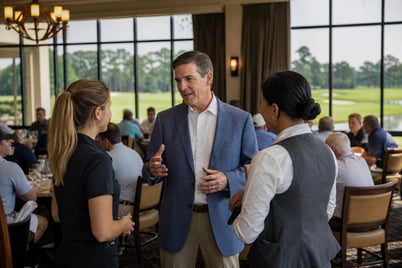
In my time as a General Manager, one of the lessons I learned was that being present mattered—but being everywhere was neither possible nor particularly effective. There was always another department to walk through, employee to check on, member to greet, meeting to attend, or operational issue that could use my attention. The challenge was learning where my involvement added value and where stepping back gave someone else the opportunity to lead.
That lesson has stayed with me.
In private clubs, visibility and accessibility matter. Members appreciate knowing their General Manager. Employees want leaders who understand the realities of their work. Department heads benefit from executives who are engaged and available. But the influence of a leader reaches well beyond the moments when they are physically present.
It can be seen in the people they develop, the expectations they establish, the decisions they enable, and the health of the organization around them.
Presence With Purpose
Meaningful presence requires more than walking through the operation.
It means listening, observing, asking questions, remembering conversations, and reading the room. Sometimes a team needs encouragement. Sometimes a department head needs guidance. Sometimes the most useful thing a senior leader can do is simply understand what is happening before deciding whether to become involved.
A General Manager can visit the first tee without taking over Golf Operations. A senior leader can spend time in the dining room without becoming the unofficial F&B Manager.
The purpose of visibility is connection and understanding, not control.
The Hero Operator
One of the more interesting leadership traps in hospitality is the "hero operator."
This leader is enormously capable. When the dining room gets busy, they run food. When a member complains, they solve the problem. When a department falls behind, they jump in. When someone has a question, they have the answer.
There are certainly moments when leaders need to roll up their sleeves. Hospitality requires that flexibility.
The concern comes when every important decision, difficult conversation, member concern, or operational challenge eventually reaches the same person.
At that point, capability can unintentionally create dependency.
Developing strong department heads requires coaching, delegation, and trust. It also means occasionally allowing someone else to approach a situation differently than we would.
For strong operators, that can be difficult. We often know exactly how we would solve the problem ourselves. Yet developing others means resisting the instinct to always provide the answer.
Over time, the strength of the leadership team becomes one of the clearest reflections of executive leadership.
Impact Shows Up Throughout the Organization
A healthy organization gives us clues about the leadership behind it.
Department heads understand their authority. Employees know what is expected. Accountability is consistent. Future leaders are emerging. Decisions are made at the appropriate level rather than continually moving up the organizational chart.
Relationships matter as well.
Private clubs are deeply personal organizations. General Managers interact with employees, members, boards, committees, vendors, and community partners, often within the same day.
The ability to move comfortably among those groups requires emotional intelligence and adaptability. A GM may discuss financial performance with the Finance Committee in the morning, address a difficult personnel matter at noon, and spend the evening welcoming members to an event.
Clarity, consistency, and genuine relationships create credibility across all of those settings.
Leadership Impact Reaches the Boardroom
The relationship between the General Manager and the Board offers another important measure.
A GM may be an excellent presenter and communicate confidently during Board meetings. A healthy governance partnership, however, is built over time through trust, appropriate information, clear roles, and shared strategic direction.
The General Manager helps provide the clarity that allows the Board to concentrate on governance, strategy, financial stewardship, and the club's long-term future while management leads operations and execution.
That means bringing forward the right information. Emerging issues are identified before they become surprises. Recommendations include context. Directors understand the operational implications of strategic decisions.
Just as importantly, routine operational matters remain with management.
When member complaints, staffing decisions, or departmental challenges regularly migrate to the Board table, the distinction between governance and management can begin to blur. Sometimes directors become too involved. Other times, management inadvertently creates that involvement by continually bringing operational decisions to them.
Strong GM-Board relationships maintain healthy boundaries in both directions.
This becomes particularly important as Boards change. Directors rotate, committee chairs transition, and new perspectives enter the room. The General Manager provides professional continuity and institutional knowledge while helping connect today's decisions to longer-term strategy.
The goal is not a Board that agrees with management on everything. It is a governance-management partnership capable of thoughtful discussion, respectful disagreement, clear decision-making, and mutual trust.
What This Means in Executive Search
This perspective becomes particularly useful when evaluating General Manager candidates.
Some executives naturally command an interview room. They make excellent eye contact, tell compelling stories, remember everyone's name, and create immediate confidence. Those qualities have value in a member-facing leadership role.
They are only part of what we are trying to understand.
Search committees can also explore what happened within the organizations candidates previously led:
- Which leaders did they develop and promote?
- How did they create accountability?
- What became stronger during their tenure?
- How did they work with their Board while maintaining appropriate governance boundaries?
- Which improvements continued after they moved on?
References become especially valuable here. Former Board members, colleagues, and direct reports can provide perspective on how the candidate actually led over time, beyond the impression created during an interview.
Looking Ahead
Some of the most meaningful evidence of leadership is easy to overlook.
It is the manager who became ready for a larger role. The employee who gained confidence. The department that learned to solve problems together. The Board that became more strategically focused because it trusts management to lead the operation. It is found in systems, relationships, and expectations that remain strong through busy seasons, leadership transitions, and changing Boards.
For clubs evaluating current leaders or interviewing future ones, that gives us a broader way to think about leadership impact.
Presence matters. Members and employees deserve leaders who are accessible, interested, and engaged.
But perhaps the more lasting question is this:
What has become stronger because this person led here?
The answer tells us far more than how often we saw them in the room.
###
About the Author: Paige Frazier

A performance-driven thought leader and transformational manager, Paige began her career in private clubs in 2001. Her progressive development has provided extensive and comprehensive training, both in Club operations and in Team leadership. She has fostered her passion for hospitality and leading with a servant’s heart, beginning with food and beverage operations, continuing through to her most recent position as a General Manager, and she continues to seek opportunities to learn and grow every day.
Paige has demonstrated an ability to streamline operations, identify and correct inefficiencies, and deliver strategic direction and initiatives that improve processes, teams, systems, and profitability. She is an influencer, with a skill set to build robust and mutually beneficial business relationships at all levels. Her expertise includes general private club management, resource planning and allocation, capital project management, membership relations and programming, cross-departmental collaboration, goal setting and attainment, procurement, talent acquisition and organizational strategy, operational mapping and analysis, and financial management, including general and cost accounting, budgets, KPIs, and forecasting. Paige also enjoys developing, mentoring, and leading high-performing teams. She thrives on creating and maintaining a positive and innovative Club culture and enthusiastically supports both teams and membership. Paige has a passion for creating vision, setting a course, and aligning people, resources, and relationships to deliver operational excellence.